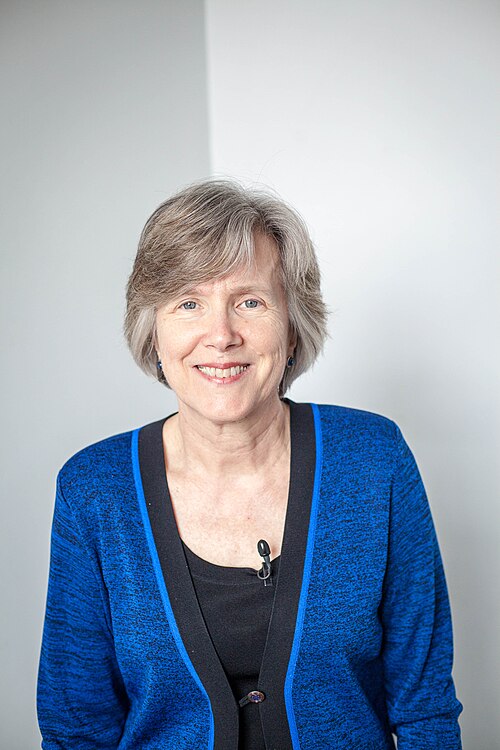
Photo: Thatcher Cook for PopTech, 2012 · CC BY-SA 2.0 · Wikimedia Commons
From the University of Minnesota
Ann S. Masten, PhD
Regents Professor Emerita of Child Development at the Institute of Child Development, College of Education and Human Development, University of Minnesota Twin Cities.
- Education
- A.B. cum laude, Smith College, 1973; Ph.D., Psychology (Clinical), University of Minnesota, 1982; clinical internship at UCLA’s Neuropsychiatric Institute
- At Minnesota
- Joined the Institute of Child Development faculty in 1986; led it as director from 1999 to 2005; Distinguished McKnight University Professor 2003–2025; retired from active faculty service in May 2025 (per her CV (opens the University of Minnesota in a new tab))
- Lab
- Directs Project Competence Research on Risk and Resilience (PCR3)
- Areas of interest
- Multisystem resilience; risk and protective processes in children and families in the context of poverty, homelessness, war, and disaster; competence and cascades; developmental psychopathology
- Record
- More than 300 scholarly works; a free Coursera course taken by learners in more than 180 countries
Facts on this page are restated from the University of Minnesota pages listed below, read on Oct 29, 2026. Professor Masten and the university have not reviewed or endorsed this site.
Research
How children do well despite adversity.
Her work follows children and families facing poverty, homelessness, war, disaster and migration, and asks which everyday protections help them adapt. The aim, in the university’s summary, is to inform science, practice and policy on promoting resilience. Much of the Minnesota work focuses on school success for children in homeless and highly mobile families, and on what can change: parenting, self-regulation and housing.
- Project Competence Longitudinal StudyBegun with Norman Garmezy in the late 1970s, it followed 205 children and their families from an urban school district for more than 20 years, and found “late bloomers” whose lives turned toward success in early adulthood.
- School Success in MotionStudies with Twin Cities shelters and schools of children experiencing homelessness and poverty: achievement, readiness, parenting, emotion and stress. Her team has worked with families experiencing homelessness since 1989.
- Ready? Set. Go!Since 2010, with Stephanie Carlson, Philip Zelazo and community partners, building ways to strengthen executive function skills that help young children from homeless and highly mobile families get ready for school.
- NIH Toolbox developmental extensionsEasier starting levels for two executive function tasks in the NIH Toolbox, so the measures work for younger children with a wider range of experiences.
- Immigrant and refugee youthStudies of Cambodian war survivors who resettled in Minnesota, Syrian refugees with colleagues in Turkey, and the Athena Studies of Resilient Adaptation (AStRA) with Professor Frosso Motti-Stefanidi in Greece.
- Homework Starts with Home Research PartnershipA University of Minnesota Grand Challenge project, established in 2017, that links state administrative data to guide policy on ending student homelessness, with Minnesota Housing and the Minnesota Department of Education.
Project details from the PCR3 major projects page (opens the PCR3 lab site in a new tab) and her faculty profile (opens the University of Minnesota in a new tab).
In the university’s words
Ordinary capacities, widely shared.
“Resilience is a capacity that’s generated by many, many factors.”
“The capacity for resilience does not require rare resources or skills, but common, everyday capabilities and resources”
“Ann Masten has been at the forefront of resilience research, starting in 1976 as a graduate student in clinical psychology”
Honors
Recognition
- 2026American Journal of Nursing 2025 Book of the Year Award: First Place in Child Health for Ordinary Magic: Resilience in Development (2nd edition), Guilford Press
- 2025Distinguished Alumni Award from the College of Education and Human Development, University of Minnesota
- 2025APF Gold Medal for Impact in Psychology from the American Psychological Foundation
- 2025Honorary doctorate, Colgate University
- 2025Distinguished Scientific Contributions to Child Development Award from the Society for Research in Child Development
- 2024Distinguished Career Contributions to Science Award, Society for Clinical Child and Adolescent Psychology (Division 53), American Psychological Association
- 2024Grawemeyer Award in Psychology
- 2022Doctorate Honoris Causa (honorary doctorate), Erasmus University of Rotterdam
- 2022Mentor Award in Developmental Psychology, American Psychological Association (Division 7)
- 2021Elected to the American Academy of Arts and Sciences
- 2019Distinguished Leadership Award, American Psychological Association Office on Socioeconomic Status (Public Interest Directorate)
- 2018Smith College Medal
- 2014Urie Bronfenbrenner Award for Lifetime Contributions to Developmental Psychology in the Service of Science and Society from the American Psychological Association
- 2012President’s Award for Outstanding Service, University of Minnesota
- 2009Elected President of the Society for Research in Child Development
- 2007Fellow, Association for Psychological Science
- 2002Elected President of Division 7 (Developmental), American Psychological Association
- 1999Horace T. Morse – University of Minnesota Alumni Award for Outstanding Contributions to Undergraduate Education
- 1997Distinguished Teaching Award, College of Educ. and Human Dev., Univ. of Minnesota
Titles as listed in her University of Minnesota CV (opens a PDF on the University of Minnesota site in a new tab), selected. Named lectures include the Wolk Lecture, Colgate University (2024) · Grawemeyer Lectures, University of Louisville (2024) · Millert Lecture, St. Olaf College (2022) · Iseman Lecture, Yale University (2015). In 2024 she gave the $100,000 Grawemeyer prize to found the Masten Award in Developmental Resilience Science, which funds students’ summer research (CEHD (opens the University of Minnesota in a new tab)).
Career
Appointments
- 1973A.B. cum laude, Smith College (Majors: Psychology, English)
- 1981–82Internship, Neuropsychiatric Institute, University of California, Los Angeles
- 1982Ph.D., Psychology (Clinical), University of Minnesota
- 1986Assistant Professor, Institute of Child Development
- 1991Associate Professor and Associate Director, Institute of Child Development
- 1996Professor, Institute of Child Development
- 1999–2005Director (department chair), Institute of Child Development
- 2003–2025Distinguished McKnight University Professor
- 2013–2022Irving B. Harris Professor in Child Development
- 2014–2025Regents Professor of Child Development
- 2025Regents Professor Emerita of Child Development (retired from active faculty service, May 2025)
From her CV (opens a PDF on the University of Minnesota site in a new tab). She is a past president of the Society for Research in Child Development and of APA Division 7 (Developmental).
Selected publications
Papers worth reading first.
A short selection: her most widely cited paper (per OpenAlex), the Project Competence overview, and recent work listed on her University of Minnesota profile. Every link resolves through its DOI to the publisher.
- Masten, A. S. (2001). Ordinary magic: Resilience processes in development. American Psychologist, 56(3), 227–238. doi:10.1037/0003-066X.56.3.227 (opens the publisher in a new tab)
- Masten, A. S., & Tellegen, A. (2012). Resilience in developmental psychopathology: Contributions of the Project Competence Longitudinal Study. Development and Psychopathology, 24(2), 345–361. doi:10.1017/S095457941200003X (opens the publisher in a new tab)
- Masten, A. S. (2014). Global perspectives on resilience in children and youth. Child Development, 85(1), 6–20. doi:10.1111/cdev.12205 (opens the publisher in a new tab)
- Masten, A. S. (2024). Emergence and evolution of developmental resilience science over half a century. Development and Psychopathology, 36(5), 2542–2550. doi:10.1017/S0954579424000154 (opens the publisher in a new tab)
- Sanson, A., & Masten, A. S. (2024). Climate change and resilience: Developmental science perspectives. International Journal of Behavioral Development, 48(2), 93–102. doi:10.1177/01650254231186332 (opens the publisher in a new tab)
- Distefano, R., Nelson, K. M., Palmer, A. R., Masten, A. S., & Carlson, S. M. (2024). The role of parenting in autonomy and executive function development among young children experiencing homelessness. Children and Youth Services Review, 166, 107997. doi:10.1016/j.childyouth.2024.107997 (opens the publisher in a new tab)
- Masten, A. S., Cicchetti, D., & Tyrell, F. A. (Eds.) (2023). Resilience in development: Pathways to multisystem integration. Development and Psychopathology, 35. [Editorial for special issue] doi:10.1017/S0954579423001293 (opens the publisher in a new tab)
- Masten, A. S., Narayan, A. J., & Wright, M. O’D. (2023). Resilience processes in development: Multisystem integration emerging from four waves of research. In S. Goldstein & R. B. Brooks (Eds.), Handbook of resilience in children (3rd ed., pp. 19–46). Springer Nature. doi:10.1007/978-3-031-14728-9_2 (opens the publisher in a new tab)
- Prime, H., Walsh, F., & Masten, A. S. (2023). Building family resilience in the wake of a global pandemic. Canadian Psychology, 64(3), 200–211. doi:10.1037/cap0000366 (opens the publisher in a new tab)
- Palmer, A. R., Piescher, K., Berry, D., Dupuis, D., Hanratty, M., Heinz-Amborn, B., & Masten, A. S. (2023). Homelessness and child protection involvement: Temporal links and risks to student attendance and school mobility. Child Abuse & Neglect, 135, 105972. doi:10.1016/j.chiabu.2022.105972 (opens the publisher in a new tab)
- Tyrell, F. A., Lucke, C. M., Nelson, K. M., & Masten, A. S. (2023). Parent’s ethnic-racial socialization practices in families with young children experiencing homelessness. Early Childhood Research Quarterly, 62, 76–88. doi:10.1016/j.ecresq.2022.07.018 (opens the publisher in a new tab)
- Stallworthy, I. C., & Masten, A. S. (2023). Advancing research on early autism through an integrated risk and resilience perspective. Development and Psychopathology, 35(1), 44–61. doi:10.1017/S0954579421001437 (opens the publisher in a new tab)
Books
- Ordinary Magic: Resilience in Development (Guilford Press, 2025, second edition) · Author
- Ordinary Magic: Resilience in Development (Guilford Press, 2014, first edition) · Author
- The Hidden Talents Framework: Implications for Science, Policy, and Practice (Cambridge University Press, 2023) · Co-author
- Realizing the Potential of Immigrant Youth (Cambridge University Press, 2012) · Co-editor
- Multilevel Dynamics in Developmental Psychopathology: Pathways to the Future (Lawrence Erlbaum Associates, 2007) · Editor
- Cultural Processes in Child Development (Lawrence Erlbaum Associates, 1999) · Editor
- Risk and Protective Factors in the Development of Psychopathology (Cambridge University Press, 1990) · Co-editor
From the University of Minnesota
Official pages, in one place.
Go to the source. These are the university’s own pages about her work, checked on Oct 29, 2026. For contact details and office information, use her official profile.
- Official profile (opens a University of Minnesota page in a new tab)Institute of Child Development faculty pageHer titles, degree, research statement, areas of interest, books and recent publications, and office details.
- Curriculum vitae (PDF) (opens a University of Minnesota page in a new tab)Institute of Child DevelopmentThe full record: education, honors, appointments, named lectures, boards, grants and publications.
- University expert page (opens a University of Minnesota page in a new tab)University of Minnesota Twin CitiesThe university’s summary of her expertise for journalists, with topic tags.
- Project Competence Research on Risk and Resilience (opens a University of Minnesota page in a new tab)PCR3 lab siteHer research lab at the Institute of Child Development.
- PCR3 major projects (opens a University of Minnesota page in a new tab)PCR3 lab siteFrom the Project Competence Longitudinal Study to the Homework Starts with Home partnership.
- Homework Starts with Home Research Partnership (opens a University of Minnesota page in a new tab)Ending Student Homelessness siteThe Grand Challenge partnership on student homelessness, with conference videos and podcasts.
- Grawemeyer Award news (opens a University of Minnesota page in a new tab)Institute of Child Development newsThe 2024 University of Louisville Grawemeyer Award in Psychology for “ordinary magic.”
- Distinguished Alumni Award (opens a University of Minnesota page in a new tab)Institute of Child Development news, Nov 2025The College of Education and Human Development honors her with its Distinguished Alumni Award.
- “Ordinary magic” feature (opens a University of Minnesota page in a new tab)CEHD Connect Magazine, Sept 2025A long profile of her ideas, with her “short list” of resilience factors and colleagues’ tributes.
- “This is why I give” (opens a University of Minnesota page in a new tab)CEHD Connect MagazineHow she turned her Grawemeyer prize into a summer research award for students.
- 2025 Spring Assembly tribute (opens a University of Minnesota page in a new tab)College of Education and Human DevelopmentThe college’s summary of her career, honors and teaching.
- American Academy of Arts and Sciences election (opens a University of Minnesota page in a new tab)University of Minnesota Brief, May 5, 2021University news noting her election to the Academy’s 2021 class.
- Research colloquium, 2024 (opens a University of Minnesota page in a new tab)School of Social Work newsHer talk on school success for students experiencing homelessness.
- Institute of Child Development (opens a University of Minnesota page in a new tab)University of MinnesotaHer academic home since 1986.